
Alone on Mars
A Flash-era 2D survival shooter on Mars with tower defence bones and a one-hour runtime.
by Gnelf · 30 Aug, 2021 · Windows
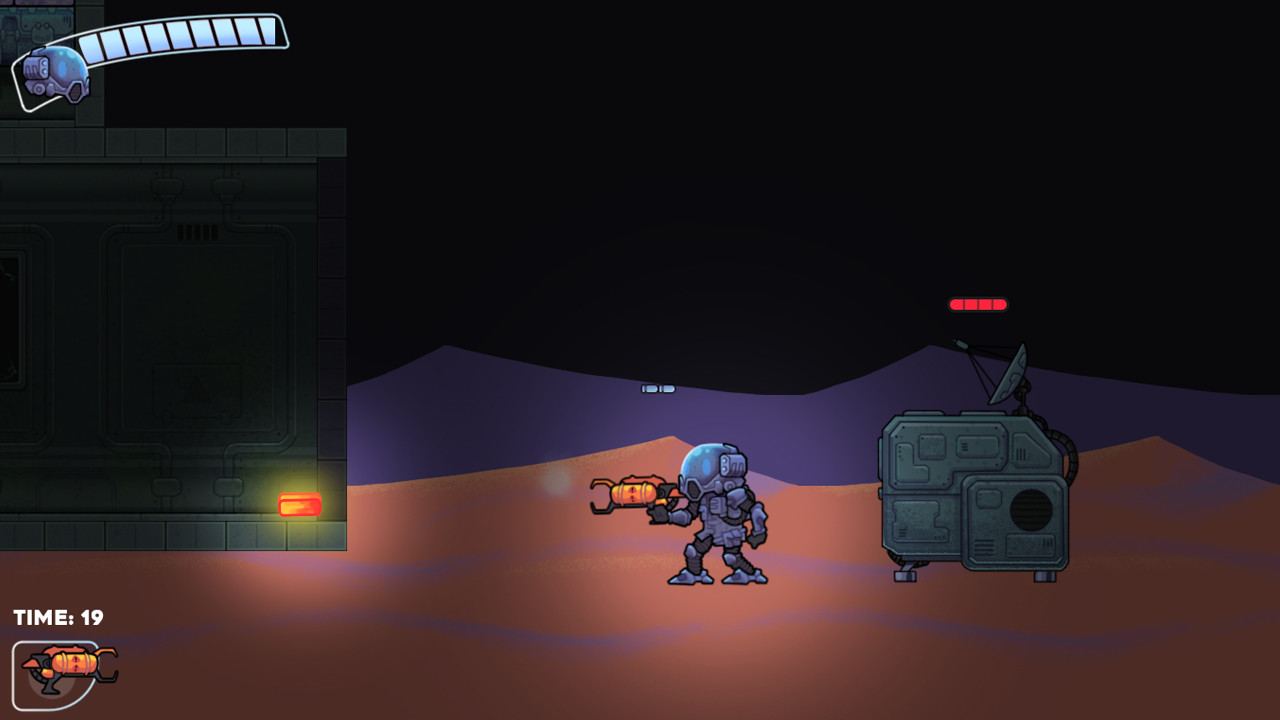
An SOS comes from Mars, you divert your spacecraft to investigate, and every station you find is full of creatures that apparently ate the previous expedition. Alone on Mars is Gnelf's 2D survival shooter, a small side-scroller with tower defence bones: you defend a generator, waves of mutants walk at it, and you shoot until the mystery of the red planet resolves itself.
It sells on Steam for pocket change, goes on deep discounts constantly, and community consensus puts the entire campaign at about an hour. That is the honest scale of the thing, and it is also the pitch.
What the loop feels like
You plant yourself near the generator, the creatures shamble out of the red dust, and you hold the line with whatever weapon the last round unlocked. The pathfinding is simple and the mutants' ambition is modest: walk at the machine, absorb bullets, repeat. That's Alone on Mars.
Between rounds you repair systems, unlock new guns, and press a little deeper into the abandoned installation, one sealed sector at a time, until roughly thirteen short rounds later the distress signal's dark little story is told. That's Alone on Mars.
The systems doing the work
The skeleton is resource scavenging and management: you source raw materials from broken-down scientific outposts, keep your life support metrics from dwindling, and treat every cleared room as inventory rather than safe haven. Narrative-driven discovery paces the game, with progression tied to unravelling the mystery that begins with the intercepted distress signal, and repairing systems with specialised components opens previously sealed or hazardous sectors of the Martian installations.
Survival scaling supplies the difficulty curve: the deeper you push, the more hostile the environment and the scarcer the resources, which pushes you toward tighter optimisation of inventory and gear routes. Veteran habits are common-sense to the point of comedy: secure redundant oxygen and health before over-extending your exploration range, treat outposts as hazards until cleared, and hoard high-tier components for critical repairs rather than early convenience crafting.
Where it stumbles
The complaints are blunt and consistent. There is no wave progress bar, no enemy counter, no timer, so you are guessing how much shooting remains, and the lack of feedback is the single most-cited flaw. The presentation recalls an old Flash browser game more than a modern indie release, from the animations to the interface. Enemies rarely threaten the player directly, which flattens the tension the story keeps promising, and the repetition sets in early because the wave formula never complicates itself. An hour is less a compliment here than a structural fact.
Playing it today
Windows only, via Steam. No iOS or Android release surfaced in our platform checks, and none is needed for a game this size. At its frequent deep discounts it functions as a one-hour time-waster, which is the most generous and most accurate thing anyone says about it.
The verdict
A curiosity, not a commitment. The generator defence loop works for exactly as long as it lasts, the mystery is serviceable, and the flaws, missing feedback, dated presentation, passive enemies, are real but survivable at the price of a coffee. If the phrase Flash-era Mars tower defence sounds like your kind of afternoon, it will deliver exactly that and nothing more.
If you like Alone on Mars
mechanic-matched
Asteroid Core
Stuck on a tiny meteor with room for twenty machines: build, defend, and rocket the artifact home before the aliens end you.

Dwarf Eats Mountain
GreatA strategic incremental about feeding dwarves to a mountain, and the logistics of getting the gold back out.

Endless Battle: Return of Hero +1
The hero fights alone. You run the spellbook, the buildings and the economy.

Fantasy Adventure
Yamate's hero-placement tower defense where merging cards and letting the fragments pile up does most of the work.