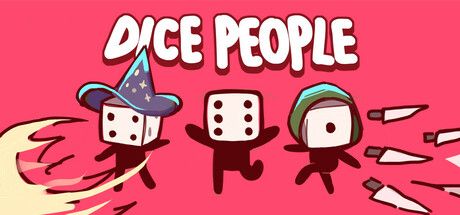
Dice People
Throw literal dice onto a stage, watch them become units, smash waves, buy the skill tree.
by Mateusk2m · 7 Mar, 2025 · Steam (Windows)
Most incremental games launder their randomness through formulas. Dice People throws actual dice onto a stage, watches them bounce into units, and lets the physics of chance do the work. Mateusk2m and Manodeix released it on Steam in March 2025 at a pocket-money price, and it found an audience almost immediately with players who wanted their numbers-go-up to have a little spectacle attached.
What the loop feels like
You hurl dice onto a battlefield and each roll converts into something: XP from the face values, damage from the units the dice become, money from the enemies those units flatten. The dice scatter, sprout a swarm of little fighters, and the wave dissolves under them. Money flows in, you spend it, the wave after falls faster. That's Dice People.
The other half of the loop happens in the shop and the skill tree. You buy more dice, which means more units, which means more resources per wave, and the branching tree spends that income on multipliers, die modifiers and automation bonuses. Every so often you hit a wall, reset for meta-currency, and push further the next time through. The randomness is somebody real rather than a hidden roll, and that makes each throw feel faintly owned. That's Dice People.
The systems underneath
The core loop is dice throwing and stage combat: values and types on each die determine damage output, resource generation and how the enemy waves get managed. Cleared enemies and stage milestones yield materials that feed directly into upgrades. Progression hangs on a branching skill tree that unlocks new die modifiers, multipliers and automation bonuses, rather than linear stage levelling. Prestige loops sit on top in the classic pattern: walls arrive, you reset for meta-currency, and subsequent runs push into higher-tier stages. Community advice converges on prioritising resource-generation nodes over raw damage early, since compounding the economy accelerates everything else, and prestiging promptly rather than stalling at a late wall.
Where it stumbles
The caveats are scope-shaped. The meaningful progression runs out faster than in sprawling idle heavyweights, so players who want hundreds of hours of runway will exhaust the content loop quickly. Once the core synergies unlock, the loop turns samey, with minimal active interaction required. Tactical agency during runs is limited compared to deckbuilders or true roguelikes; this is an incremental first and a strategy game a distant second. Community notes also flag the skill tree as slightly confusing, with dead-end paths that punish unplanned spending, and some launch-window complaints about optimisation and minor bugs.
Playing it today
Dice People is a paid Steam release for Windows, listed at A$4.50. Our platform check found no iOS or Android builds, so desktop is the whole story. If the dice-and-swarm idea lands for you, the catalog's Incremental Dice scratches a related itch. The store page is the single, same-dev destination: Dice People on Steam.
The verdict
Dice People is a coffee-break incremental that knows its size. The physicality of throwing real dice onto a stage gives it a personality the genre's endless multiplier menus lack, the skill tree gives the randomness somewhere to compound, and the price asks almost nothing. It will not colonise your life for months, and it does not try. As a short, cheap, well-liked spin on the idle formula, it punches well above its weight.
If you like Dice People
mechanic-matched
Upload Simulator
Download files, upload them, buy a bigger pipe, repeat until your desktop setup resembles a data centre. A minimalist transfer-economy incremental.

Incremental Factory
A factory builder with the belts removed: node-based production chains, blueprint prestige loops, and one hyperdrive to build.

+1x2
Two buttons, one quadrillion: add a temporary +1 or double everything forever.

AdVenture Communist
Worth your timeThe idle game with missions instead of mindless clicking: potatoes in, Supreme Einsteins out.