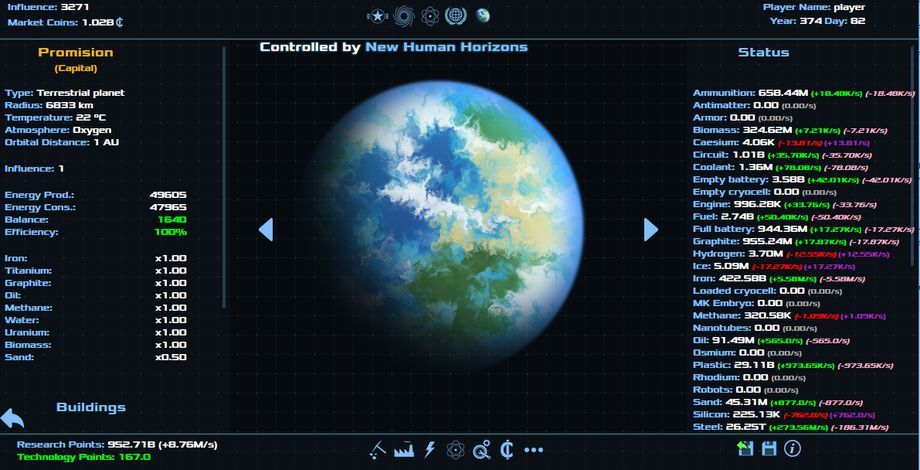
Heart of Galaxy: Horizons
An idle space empire built on freight: automate the supply lines, then time travel the rest.
by Cheslava · 20 November, 2017 · Web
Somewhere in the Heart of Galaxy: Horizons comments there is a player with 69 planets, 20 fleets of 10,000 ships each and a shopping list of resources measured in quadrillions, calmly explaining to a newer player which order to take the galaxy in. The guide they followed is called "Conquering VOID - Personal experiences", and it ends, the way these guides do, with: "69 planets, and now I will time travel again..."
That player is describing the game in full. Heart of Galaxy: Horizons is a space-empire incremental by Cheslava, released on Kongregate in November 2017 as the expanded second act of the original Heart of Galaxy beta. Mouse only, HTML5, one Earth-like starting planet, and a very long way up from there.
The pitch sits somewhere between a 4X strategy game and a logistics spreadsheet. You start on one world with a modest industrial base. From there the game keeps adding scope: colonies, autoroutes, hub fleets, alien diplomacy and, eventually, a time travel loop that resets the galaxy but keeps your tournament artifacts.
New players mostly report the same arc. The tutorial is good, the early planets are calm, and then somewhere around the third system the production tabs start outnumbering the screen.
What the loop feels like
You queue a mine on your home world, and the mine hires drones, and the drones dig ore that pays for the physicist who will eventually invent the drive that reaches the next system. That's Heart of Galaxy.
You colonise a dead rock two systems out, and it arrives raw: no infrastructure, no surplus, no reason to exist yet. You bootstrap it by hand until its conveyor of parts lines up with somebody else's shortage. That's Heart of Galaxy.
You set an autoroute so a cargo fleet commutes between two planets forever, then commission hub fleets that deliver construction materials the moment you queue a building, and you go and make tea. That's Heart of Galaxy too.
The bottleneck is the fleet
Most space incrementals let you throw ships at a number. This one makes the ships commute.
Fleet speed is bound to the slowest hull in the group, so a fast escort stapled to a convoy of heavy haulers travels at hauler speed. Mix fleets carelessly and you can lose days of game time without ever seeing a battle.
The answer is automation with a personal touch from the developer. Autoroutes are cargo fleets that run a fixed line between two planets indefinitely, and hub fleets are the smarter layer: park one near a colony and it ferries in whatever the next building needs, in the quantities the game works out for you. The community's player guides are essentially a cookbook of these arrangements.
Combat is where the economy cashes out. Shields subtract: damage equals attacker power minus defender shields, times ship count, which is why the wiki community keeps battle calculators on hand. Ship types have personalities, too. The Munya strips enemy shields so everything else hits harder, the Siber pierces outright, the Alkantara adds damage, and one strategy comment from this February argues you take all three and skip the popular Skydragons entirely.
War also pays rent. Raid a planet and its resources are yours, but raid too fast and an internal counter starts dividing your take until it decays. The genre's usual exploit-at-your-leisure arrangement, written directly into the maths.
Governments, merchants and other fine print
- Fleet speed is set by the slowest ship in the group. Fast escorts and heavy haulers do not travel together unless the schedule has room for both.
- Raiding has diminishing returns built in: an internal counter rises with each raid and decays over real time, dividing your take until it drains.
- Time travel, the prestige loop, resets the galaxy, but tournament artifacts stick through it, so tournament seasons shape when you reset.
- Characters arrived in the March 2019 update: quest rewards from the Fallen Human Empire and tournaments, each with a passive bonus. Sebastian Jones gives 5% influence per human-empire planet while empire government is active; Captain Seris toggles the Auxilia Betas between attack and defence modes.
- Offline progress works, and the cloud save needs registration. A late-game empire with dozens of routes still wants periodic check-ins to clear the bottlenecks it built while you were away.
Where it came from, and whether it still runs
Cheslava built Horizons in the open, posting every version to Kongregate's Developer Updates feed from launch through v43D in May 2019, and answering comment threads personally. One of the game's most-liked comments is a plain thank you for exactly that.
The Armor Games port followed in November 2018 and has since crossed a million plays. The changelog trail ends in 2019, the year a Google Play version was announced. That listing is gone now, so the browser is the way in.
In 2026 the Kongregate build is temperamental for some players. Recent comments describe the frame flashing once and going dark, and one player got it running on an older browser and blamed the ad wrapper instead. The pragmatic advice in the threads is to export your save and keep a copy. Nine years old and hosted on a modern storefront, it sometimes asks for that kind of patience.
Reception has aged well in its niche. The praise, from 2017 through this year's comments, is depth: "Very deep, very well designed idle game with an active dev", as a top comment from release day puts it. The complaint is tedium, and it is the same complaint in 2017 as now: once resource and structure types multiply and planets specialise, some buildings become useless and the interface starts fighting you. Both reactions describe the same game, and the release thread in r/incremental_games reads the same way.
If you want an incremental that treats freight as the main event, this is one of the old masters of the school. The Void is patient. Your autoroutes needn't be.
Gameplay videos
Community
This game is essentialy a space-based incremental/idle game.
If you like Heart of Galaxy: Horizons
mechanic-matched
NGU IDLE
GreatNumbers Go Up: the #1 rated Kongregate idle, Steam's definitive big-number sandbox.
Paragon Pioneers 2
Worth your timeTondersss's city-building idle, sequel generation: settle islands, automate everything, prestige the archipelago.

Increlution
Time is the resource, the queue is the weapon, and death is just the next generation's advantage.

(the) Gnorp Apologue
Worth your timeTiny gnorps mine a giant rock for shards, and you help them in the most efficient ways possible. Overwhelmingly Positive, and it earns it.