
Magic Research
Run a magic academy, win the Tournament of Magic, and actually finish the game. Very Positive, with a real ending.
by Maticolotto · 2023 · Steam
Magic Research opens with a job offer most headmasters would decline: you are put in charge of a brand new institution of magic, and the prestigious Tournament of Magic is coming whether the school is ready or not. Maticolotto's text-based incremental wears its genre on its sleeve, but underneath the wall of numbers sits something the genre rarely ships: a plot, an ending you can actually reach, and a campus you can walk through in your head. The community rates it Very Positive on Steam, and the recurring praise is that it respects your time in a way endless idlers do not.
What the loop feels like
You queue a school's worth of spells, lumber trickles in from the campus buildings, and a new discipline flickers awake. That's Magic Research.
Your headmaster walks into a dungeon, a silence effect strips your rotation, and the boss wins this round. That's Magic Research.

You Retire, the campus resets, and your peak school levels come back as permanent currency. That's Magic Research.
The systems under the tower
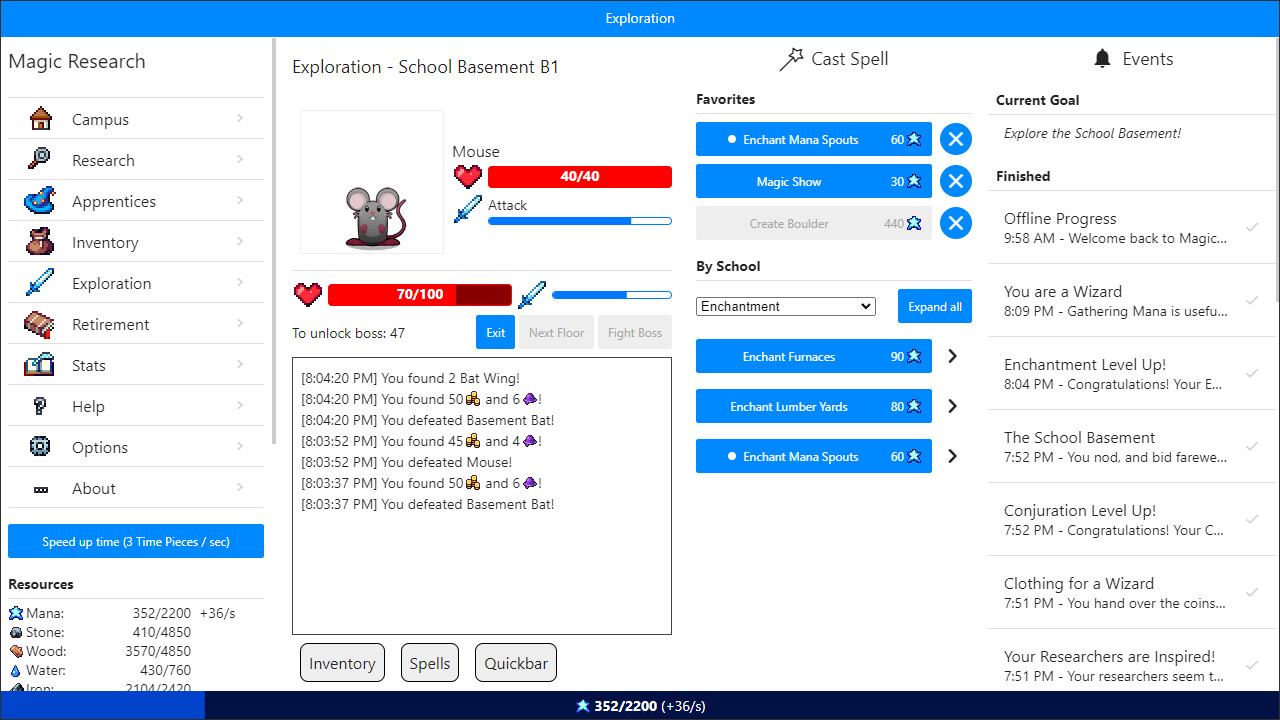
The magic schools are the spine: Conjuration, Enchantment, Illusion, Evocation, Protection, Alchemy, Summoning, each mixing active and passive spells, from summoning basic resources to casting economic illusions or unloading massive combat magic. Campus building gives the numbers a body, since lumber, iron and water produced by your structures feed back into research and upgrades. Exploration is unusually active for an incremental: you gear your character, slot a quick bar of active and passive spells, manage stuns and silences, and fight bosses for story milestones. Apprentices and researchers then automate gathering, casting and research until the setup hums on its own. The Retirement spiral is the prestige heart, resetting campus progress while paying out currency based on peak school levels, and story chapters layer permanent upgrades that survive every retirement. The standard advice holds: focus one primary school early to maximize the bonuses, and let breadth come later.
Where it stumbles
The early game is the filter: heavy clicking and active management before apprentices take over, and some players bounce before the automation arrives. The interface draws honest criticism as busy or clunky once menus expand, and one recurring player quote calls the UI a real pain even while praising everything under it. Offline progress is thin, and repeated retirements in the opening chapters can feel tedious. The counterweights: a tight 40-to-60 hour loop with an official ending, no ads, and none of the subsystem bloat of sprawling contemporaries.
Playing it today
Live on Steam at a budget price, single-player, Windows. The developer's verified iOS release is Magic Research 2, the sequel rather than this game, so check which one you are buying on mobile; the first game's home is desktop.
The verdict
One of the best text incrementals of its era: structured, finite, and genuinely story-driven, ideal for players who want to beat a game rather than maintain one. When the ending lands and you want another arcane grind, Tap Wizard 2 swaps the library for the arena.
If you like Magic Research
mechanic-matched
Magic Research 2
A text-forward wizard RPG where 120+ spells, eight elements and a team of auto-casting Wizards conspire to hand you the Philosopher's Stone. Very Positive.

The Girl's Moving Castle
A mobile castle RPG where the gacha dopamine is all there and the wallet damage is not. Collect companions, automate battles, keep the crystal alive.

Almost a Hero
GreatTen useless heroes, one idle RPG, and the slow march toward almost mattering.

Idling to Rule the Gods
GreatTrain under the gods, beat the gods, become the god: Shugasu's long-running pet-raising god idle.