
Astrodle
Shoot blobs in orbit around a Zodiac star, harvest their essences, build a drone fleet, and become an immortal space god in a weekend. A finished incremental, not an infinite one.
by Robin Nicolet · 19 Jun, 2024 · Steam (Windows)
Astrodle is an incremental game that refuses to be infinite, and says so on its own store page: both game modes have an end that can be reached in about a day of active play, ideal for a lazy weekend. Robin Nicolet's space shooter, released on Steam in June 2024, drops you at a central Zodiac Star with a laser, orbits full of Blobs, and a quest to collect the essences of the Zodiac on the way to becoming an immortal space god. The Very Positive crowd includes a vocal r/incremental_games contingent that keeps recommending it to newcomers, which is rare air for a paid indie incremental.
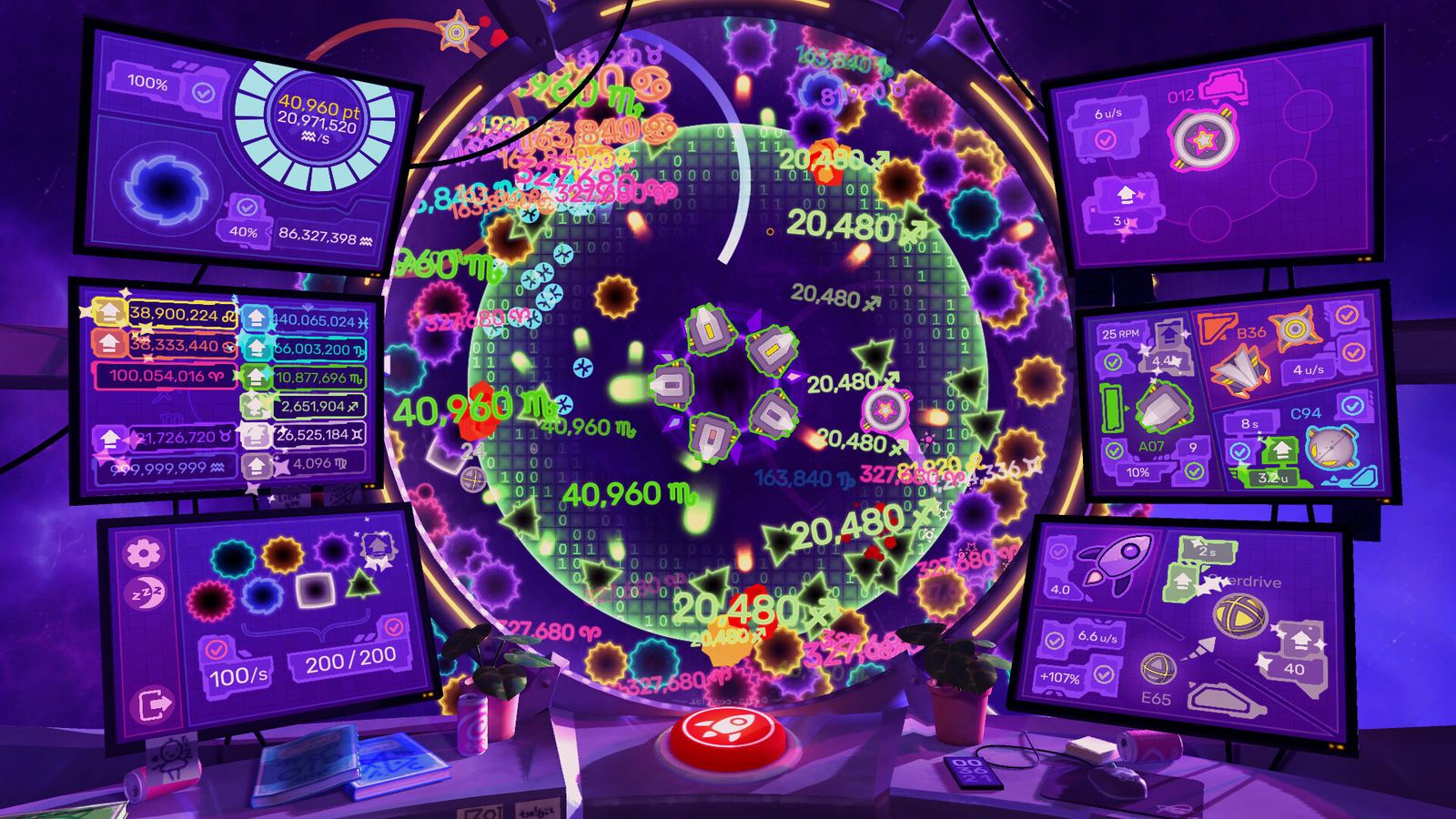
What the loop feels like
You orbit the star, snipe blobs with your laser, and their essences drift home to your wallet. That's Astrodle.
A Gunner drone takes over your firing duties, a Chaser rams the stragglers, and your aiming finger starts a slow retirement. That's Astrodle.
The screen fills with numbers, the essences become exponentially more exotic, and Sagittarius starts talking to you like you have known each other for eons. That's Astrodle, and it is the rare idler where the credits are a scheduling question rather than a hope.
The systems under the stars
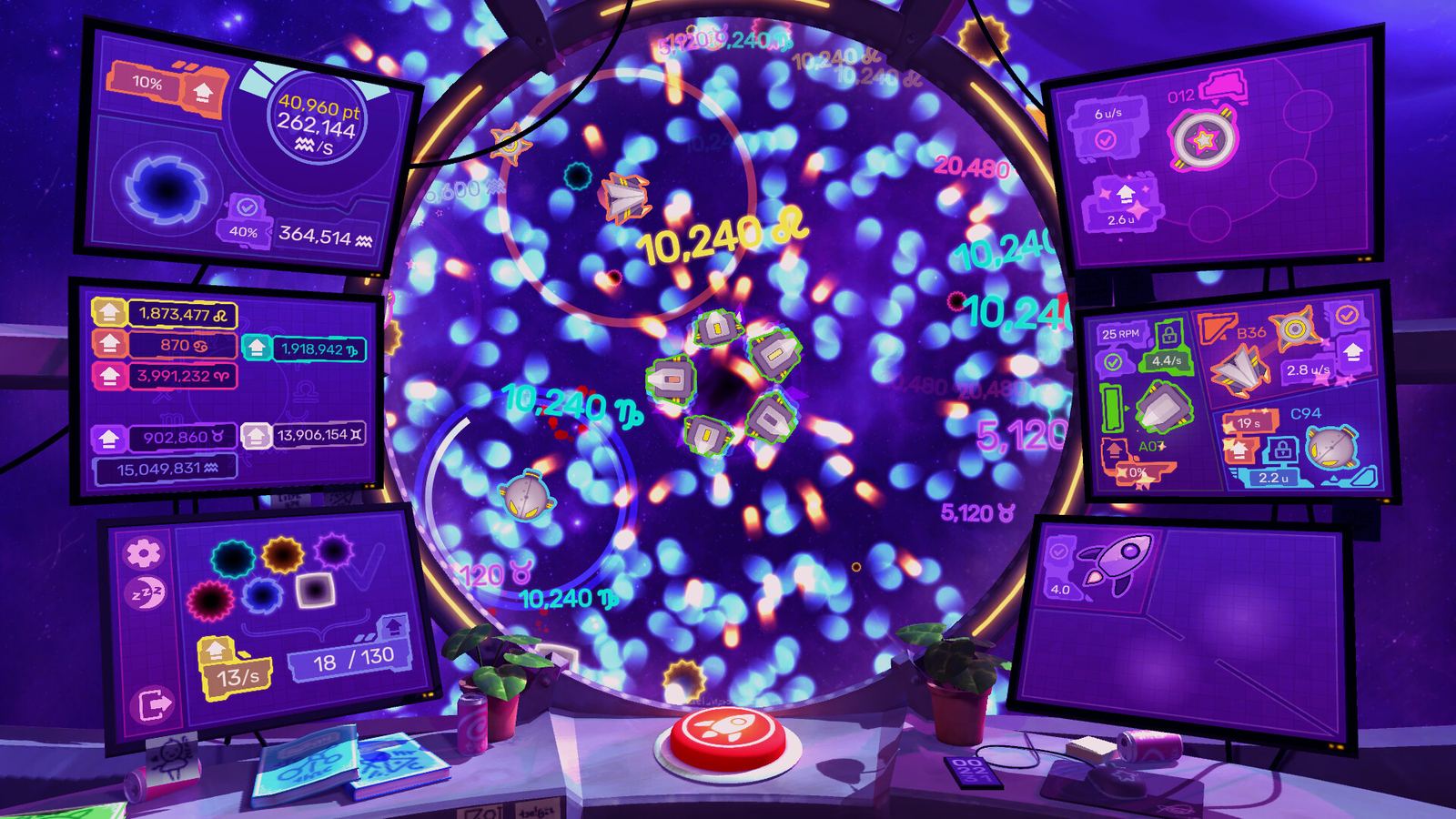
The combat layer is orbital and legible: blobs keyed to zodiac signs like Aries and Capricorn spawn into orbit around your position, and destroying a specific type yields its corresponding Zodiac Essence, the game's primary upgrade currency. The automation layer is the satisfying part. The Gunner is an orbiting drone that fires at nearby blobs on a cooldown, with upgradeable velocity, fire rate and utility; the Chaser C36 is a physical hunter that destroys blobs on contact. Between them, your active aiming converts first into support, then into supervision.
The economy deepens at milestones: the Aquarius generator introduces passive resource generation that must be fueled by completing specific micro-missions, tying idle income to light active engagement. A continuous mission system dishes out dynamic mini-objectives with achievement points, giving every session a short-term spine. The story layer is what elevates it above its genre's usual silence: Sagittarius, Aquarius and Taurus guide your deification, and the game has an actual narrative ending, twice, across its two modes.
Where it stumbles
The community's main caveat is runtime: veteran incremental players report finishing the main content in roughly ten to twenty hours, around five or six per mode, and some feel that is short for the price. The other recurring note is that this is more active than its idle label suggests: true background progress is limited, and the game wants you present, shooting and missioning. Players seeking the endless hundreds-hour curve of genre heavyweights should adjust expectations; this is a designed, finite arc, and its brevity is inseparable from its polish.
Playing it today
Live on Steam for Windows at a low price, single-player, with Steam Cloud and achievements. The platform check found no iOS or Android release by the same developer, so there is no legitimate mobile version to link. Fully offline once installed, and a perfect weekend-length commitment.
The verdict
The best argument on Steam that incremental games can have endings, and one of the prettiest, with an active-but-relaxing loop that eases you from aiming to supervising. Buy it as a finite experience, not a second-life commitment, and it over-delivers. For another automation-flavoured take on watching numbers soar, Idling Gears is smaller and cheaper, and for the genre's infinite deep end, NGU Industries will hold you for years instead of hours.
If you like Astrodle
mechanic-matched
AdVenture Communist
Worth your timeThe idle game with missions instead of mindless clicking: potatoes in, Supreme Einsteins out.

Berry Picker
Pick berries off an infinitely upgradeable bush, hire garden gnomes, and fire the harvest out of a cannon.

BubbleByte
Worth your timeA game about cats and bubbles, from Vittorio Romeo of the Desolate series.

Campaign Clicker
Worth your timePick a side, click for votes, win the 2016 election. Springloaded's political time capsule.