Galactic Simulator
An idle clicker built on the Drake Equation and the Great Filter, where civilizations rise, stall and filter themselves out while you watch.
by PcZ Games · 28 Jan, 2025 · Steam (Windows / macOS)
Somewhere in the design document for Galactic Simulator, somebody wrote the Drake Equation down and did not cross it out. PcZ Games released this in January 2025, and it is a clicker in which you do not conquer a galaxy so much as watch one try: you seed star systems, nudge planetary environments, and observe civilisations climbing the Kardashev scale, all under a real model of the Fermi Paradox.
What the loop feels like
A star forms. Around it, a planet settles into a habitable range, and organic molecules start to stir. You direct simulation energy into stabilising biomes, adjusting stellar parameters and triggering leaps for the species under your watch. That's Galactic Simulator.
Then the Filter applies. Each stage of the model, from self-replicating molecules to prokaryote, eukaryote, multicellular life, intelligence, tribe and civilisation, carries a probability of failing, and most of your civilisations do fail, quietly, at some bottleneck you never got to intervene on. Every so often one makes it through and starts broadcasting, and the galaxy gains a dot of light that was never guaranteed. That's Galactic Simulator.
The systems doing the work
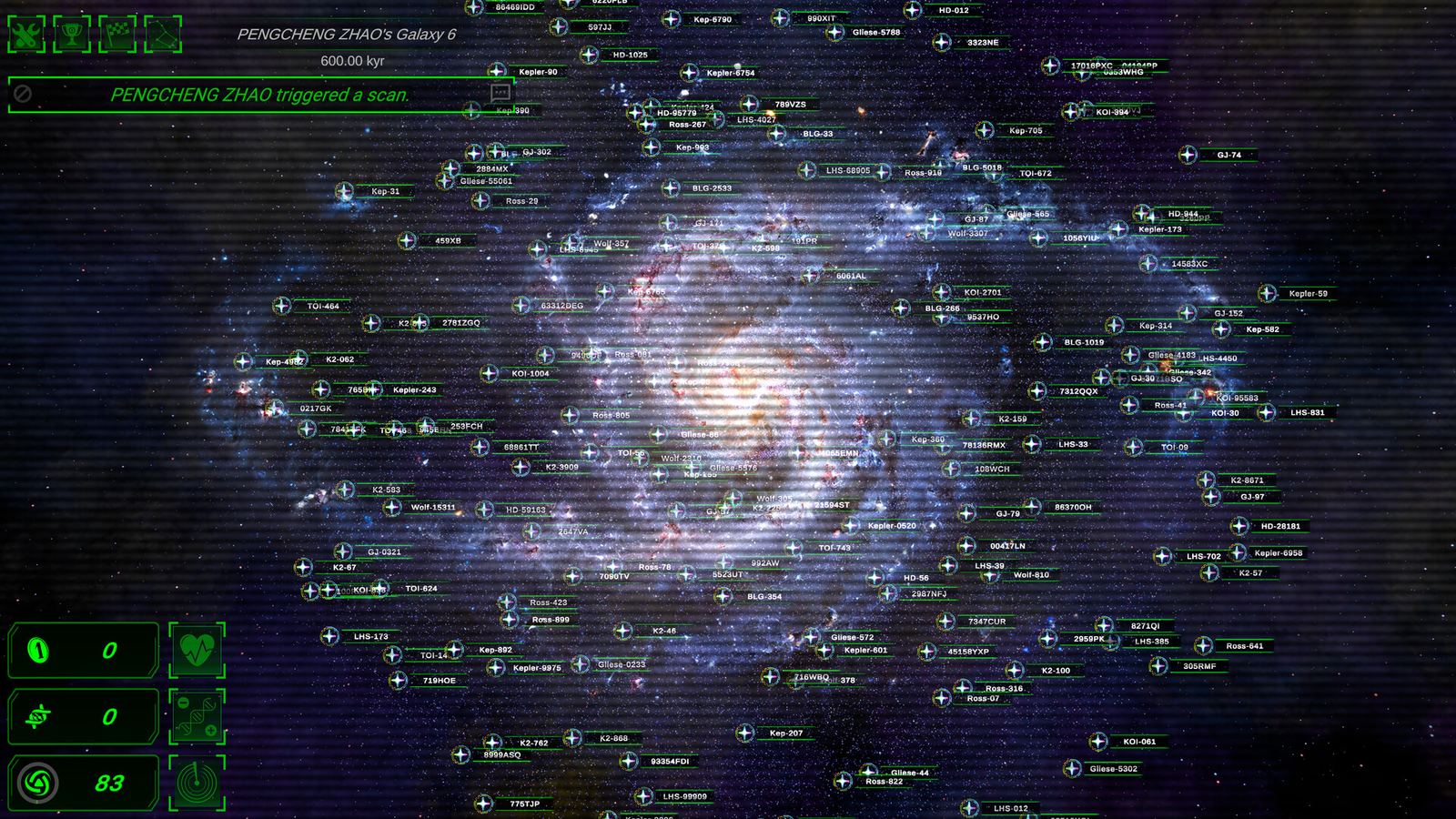
The Drake equation's components are all present as mechanics, so the game is an argument about cosmic rarity dressed as an incremental. The named systems are the observer economy, simulation energy accumulating passively and spent on biome stabilisation, stellar parameters and evolutionary leaps; the Great Filter thresholds, the bottleneck stages that gate every civilisation; and the milestone track, twenty-seven achievements spanning galactic development and cosmic catastrophes. There is online co-op too: you can share a galaxy with friends, splitting up sectors or running complementary evolutionary experiments, which prevents early civilisation collapses and speeds the whole simulation up. Community guidance favours timing interventions rather than constant ones, and focusing early energy on biome stability and resource yields from key systems.
Where it stumbles
Community feedback is blunt: progression is extremely slow, your influence on outcomes is small even when you intervene, and some UI elements and achievements have been reported buggy. One reviewer's framing is the honest pitch: bought cheap and left running in the background, it is great; approached as an active strategy game, it disappoints. It is an ambient instrument, not a 4X. Next to Cell to Singularity it trades polish for a stricter scientific spine.
Playing it today
It is a budget-priced Steam release for Windows and macOS from PcZ Games, with Steam Cloud and leaderboards, and no verified phone listings. Buy it as a background galaxy, not as a hobby, and let the filter do the dramatic work.
The verdict
A genuinely interesting idea that knows it is a screensaver. As astrobiology-flavoured idle material it has no real competition, and that alone justifies its quiet corner of the catalogue.
Community
If you like Galactic Simulator
mechanic-matched
AdVenture Communist
Worth your timeThe idle game with missions instead of mindless clicking: potatoes in, Supreme Einsteins out.

AI Tycoon
A satirical idle clicker about replacing every job on Earth with AI, one agent.exe click at a time.

Astrodle
Shoot blobs in orbit around a Zodiac star, harvest their essences, build a drone fleet, and become an immortal space god in a weekend. A finished incremental, not an infinite one.

Bar Breaker
A clicker where the boss is the health bar itself, and it heals out of spite.