Mr. Mine
Dig deeper, meet the Golem, never sell your isotopes: Playsaurus's long-digging mining idle.
by Playsaurus (web original by Rafa) · 30 September 2020 (Steam) · Steam / iOS / Android
The first rule of Mr. Mine gets posted on the game's own forums roughly once a week, usually by someone who learned it the hard way: never sell your isotopes. Not for quick cash, not in a pinch, never. Every veteran in the thread repeats it like a safety briefing, and the reason why is a decent map of what this game actually is once you get past the cartoon drills. Underneath the cheerful sprites sits a slow-burning economy with an endgame that measures itself in thousands of kilometres.
How the drill thinks
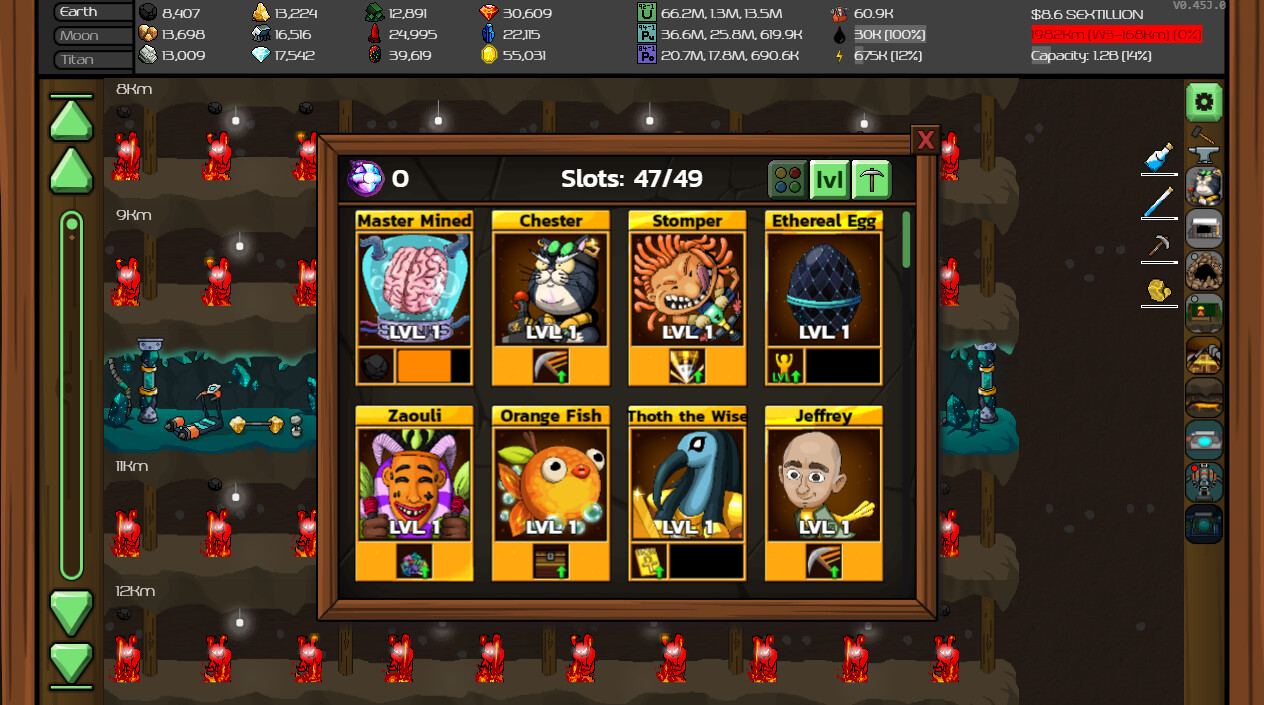
A drill in Mr. Mine is four parts: an Engine, a Cooling Fan, a Drill Bit and a Cargo Hold. The Fan and the Bit set your base wattage, the Engine multiplies it, and the Cargo Hold decides how much ore you can carry before you have to sell. Every kilometre of depth has a fixed difficulty value, and the game simply divides that by your drill power to work out how long the next kilometre takes. That one sum explains most of the pacing. A five per cent engine upgrade sounds trivial until you notice it shaving real hours off the drive to kilometre 214, because difficulty scales exponentially and small percentage gains compound into whole evenings.
Each part upgrades through blueprints, bought from vendors, won from gold chests or traded at the Trading Post, and here is the wrinkle that separates careful players from rich ones: blueprints overwrite rather than stack. Skipping tiers is the actual strategy. Land a higher-level drill bit out of a gold chest and you leapfrog an entire rung of the money grind, saving materials you will badly want a thousand kilometres later.
Three scenes from the shaft
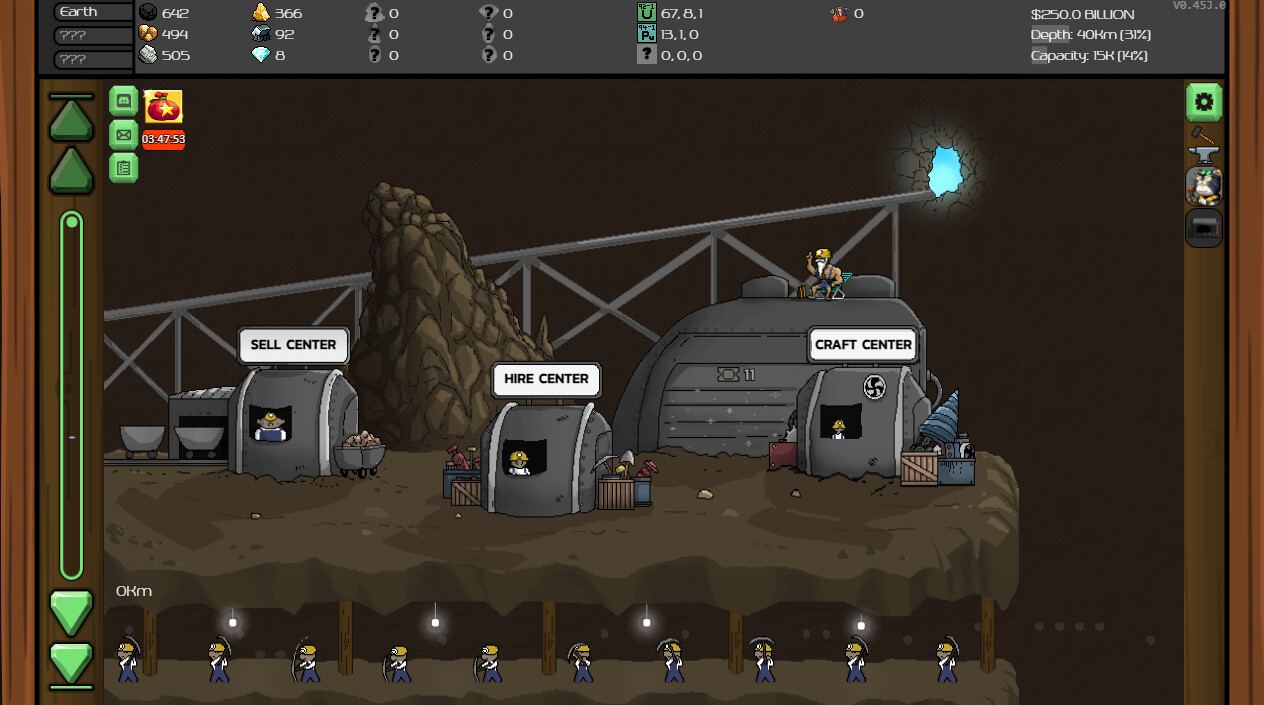
You hire a miner for a fistful of coal money. He hops into a shaft, and by morning there are ten of them down there hauling ore while your laptop is shut. Each shaft holds up to ten miners, they work offline, and past forty kilometres they even start digging up treasure chests on their own. That's the dig.
At ten kilometres the Super Miners arrive, and they are specialists rather than hands. One rides your drill to make it spin faster, one boosts mineral yield in her depth range, one finds chests, one simply sells things so you don't have to. You don't click more. You manage better. That's the dig.
At fifty kilometres the Golem is waiting under the rock with blueprints in his pockets, and your newly hired scientists are off on excavations, hauling back relics that quietly boost everything you own. The mine stopped being a clicker somewhere around kilometre thirty and became a little civilisation. That's the dig.
The milestone map
Depth is the game's real tech tree, and the milestone ladder is worth knowing in advance because several unlocks change how you play. Ten kilometres brings the Super Miners. Fifteen opens the Trading Post. Forty-five unlocks cave exploration. Fifty introduces the Golem, relics and scientists. One hundred gives you the Chest Collector, and at 225 the Broken Robot starts selling new tiers of drill parts. Around 300 the Underground City opens with its Oil Pump, Forge and weapons. The Core waits at 501, a strange thing called the Chess Compressor at 700, and at 1,000 kilometres you finally get the Reactor and the Buff Lab. Past that, endgame content runs to a current cap of roughly 2,566 kilometres.
And then the mine leaves the planet. The Rocket program carries your operation to the Moon and later to Titan, each world with its own strata, its own vendors and its own isotopes. Earth's ladder tops out in the high hundreds, the Moon's nitrogen and helium sit around kilometre 1,067 and beyond, and Titan's hydrogen waits near 1,849. Over 2,500 kilometres of content in total, which is an absurd number for a game you can play in a browser tab, and somehow the drill still feels like it is going somewhere rather than treading ore.
Isotopes: the currency that matters
Which brings us back to the rule. Isotopes are the rare materials that start appearing at 24 kilometres, first uranium, then plutonium, then polonium as you descend, and the temptation is to sell them because the buyback prices look enormous. Don't. Isotopes feed the Reactor, which converts them into energy for powerful buffs, and they are required for high-level blueprint crafting. Some materials, like einsteinium and fermium, don't spawn in any shaft at all and only exist because the Reactor makes them. Sell your stockpile at kilometre 60 and the late game simply does not happen. The community guide's phrasing is harsher, but the arithmetic is the same.
The quiet companion skill is cargo discipline. Your hold determines how much a timelapse or an overnight session can actually bank, so an upgraded cargo bay is not a convenience, it is the difference between eight hours of collected ore and eight hours of spilled ore. The same thinking applies to the cave inventory, which caps at 36 slots and will happily eat your golden chest rewards if you hoard carelessly.
Caves, chests and a certain Mr. Mime
Caves are the mid-game's mood swing. From kilometre 45 you send a drone into hand-drawn caverns, managing its fuel while it dodges hazards, scoops mineral piles and occasionally meets legendary guardians. Golden chests, the good ones, drop roughly once every 150 chests opened, and ethereal chests are rarer still, which is why the community treats a golden drop like a small holiday. There are secret achievements, obscure quests and, for no reason anyone has ever satisfactorily explained, a Mr. Mime hiding somewhere down there. The wiki documents him. Nobody agrees why.
The pedigree explains the polish. Playsaurus made Clicker Heroes, one of the few idle games your non-idle friends have heard of, and Mr. Mine began as Rafa's browser original before Playsaurus picked it up, rebuilt it and shipped it to Steam in September 2020. It has been updated continuously since, across web, Steam, Windows, Mac, Linux, iOS and Android, and it sits at Very Positive on Steam, around 91 per cent of more than thousands of reviews. Long-running web games that survive a Steam port usually come out the other side either abandoned or ruined. This one came out bigger.
The verdict
Where to play
The game runs on Steam (Windows), and it travels: the same game is available as a mobile version on iOS and Android. The mobile build carries the full progression loop, which means the numbers keep climbing whether you are at a keyboard or waiting for a bus.
Mr. Mine is the rare idle that respects both kinds of player: the one who checks in twice a day and the one who wants a spreadsheet. The drill maths is honest, the milestone ladder keeps paying out new systems for well over a thousand kilometres, and the isotope economy gives the whole thing a spine that most digging games never grow. It is cheerful on the surface and quietly deep underneath, which is exactly what a game about digging should be. If the genre has a comfortable middle-distance runner, this is it, and it is free to find out.
Play Mr. Mine on Steam, or dig for free on the web at mrmine.com.
Gameplay videos
If you like Mr. Mine
mechanic-matched
Idling to Rule the Gods
GreatTrain under the gods, beat the gods, become the god: Shugasu's long-running pet-raising god idle.

Wizard And Minion Idle
Worth your timeA wizard, a minion, and ten thousand hours of synergies: WAMI, the deep-end Steam idle.

Anti-Idle: The Game
GreatTukkun's monument to doing several games' worth of things at once: an idle RPG with 600+ achievements.
Clickpocalypse II
GreatA free, mostly idle RPG: five heroes, 35 regions, and Minmaxia's dungeon-crawler epic.