
Space Lich Omega
An ASCII-art Candy Box-descendant, still served by its author, with a sequel preserved in source.
by Zertuk (Nora Forcier) · 2014 · Web (zertukis.com)
Space Lich Omega is Zertuk's ASCII-art incremental RPG, a Candy Box descendant that is unusually alive for its age. Nora Forcier built the original as a text-and-characters dungeon crawl where you fight waves of monsters and idle your way toward the Space Lich himself, and unlike most of the genre's early browser era, it still runs at its author's own domain, verified live at slo.zertukis.com. A 2016 sequel, Space Lich Omega 2, rebuilt the idea in Angular and Firebase, and its source survives on GitHub even though the sequel's own domain has since been squatted by spam.
The lineage matters. Candy Box, by aniwey, proved that a terminal-looking page could hide a real RPG with quests, items and absurd late-game secrets, and Space Lich Omega took that recipe and made it explicitly idle: the fights resolve on their own, the loot accumulates, and your job is to notice when the numbers have outgrown the current enemy. It is a game you keep open in a background tab and visit like a hamster cage.
What the loop feels like
You click into a fight, the ASCII lich takes its swings, and your character walks away with better gear than the fight deserved. Ten minutes later the same fight is a formality. That's Space Lich Omega.
Then the progress bar at the edge of the screen stops moving, and you realize the game has been politely waiting for you to find the next thing. You poke a menu you had ignored, and it was the whole game. That's Space Lich Omega.
How it actually works
Three layers carry the game. First is the idle combat loop: waves of monsters resolve automatically, generating loot and experience while you watch or while you do not. Second is the gear-and-upgrade economy, where spoils translate into the stats that make the next wave a formality. Third is exploration of the interface itself, in true Candy Box fashion: the game hides content behind menus, odd items and narrative beats that only appear once you have ground past a threshold. The sequel iterates on all three with a more modern web stack, which is why its open-source preservation on GitHub matters to the genre's historians.
Where it stumbles
The presentation is the point, and also the toll. Everything is monospace characters, so readability depends entirely on your affection for ASCII, and there are no screenshots to admire along the way. The balance leans on long quiet stretches where the correct move is to wait, and the sequel's official distribution is effectively dead: the original spacelichomega2.com no longer serves the game, leaving the GitHub source as the only legitimate route. For a series about preservation-minded simplicity, that irony is on the nose.
Playing it today
The original is free at the author's own hosting, and it needs nothing but a browser tab. The sequel is preserved as source at its GitHub repository rather than as a hosted page. If the ASCII lineage is what draws you, Candy Box 2 is the genre's crown jewel, and A Dark Room takes the same restrained presentation somewhere darker and stranger.
The verdict
A two-generation text-RPG series with one surviving game and one surviving repo. Space Lich Omega is the genre's ASCII line documented at both ends: play the original while the author's hosting holds, and clone the sequel while GitHub does.
If you like Space Lich Omega
mechanic-matched
Legend of the Fallen Warrior
An alpha warrior idle with CC-licensed art and a credits list longer than some AAA games.

Loot Box Clicker
A loot-box satire that knows what it is: adventures run, chests open, the rarity wheel spins.
OSTM
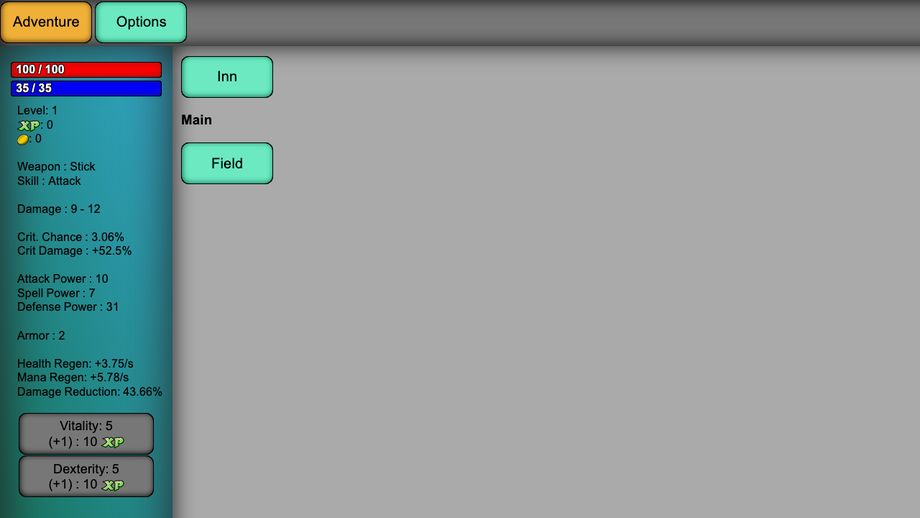
An RPG-flavored incremental with health bars, an inn, and a decade of quiet updates.
Realm of Decay
A dark-fantasy semi-idle RPG: v1.1 alive on GitHub Pages, galaxy.click, and the original build.