
Ten Seconds Trillion
Reach one trillion in ten seconds: a clicker built like a speedrun, with prestige instead of patience.
by PELMENI GAMES · 21 Mar, 2023 · Windows
Every idle game eventually asks how long you are willing to wait. Ten Seconds Trillion asks something stranger: can you turn a handful of clicks into one trillion dollars inside a ten-second window? PELMENI GAMES built the whole game around that inversion when it hit Steam in March 2023, and the game ends the moment you master it. No endless ladder, no prestige of prestiges; one number, one clock, done.
The framing is deliberate. The developer describes it as a clicker with simple goals but addictive gameplay, built as a game they wanted to play themselves, and every line of the store copy pushes toward the same endpoint: reach one trillion of value, and finish. In a genre built on infinite playthroughs, a definitive endpoint is the actual selling point.
What the loop feels like
Your first runs will not fit in ten seconds, and that is the point. Raw clicks earn a rounding error of the goal, the early grind is genuinely punishing, and the clock is a finish line you are nowhere near crossing. Buying your first upgrades is an act of faith. That's Ten Seconds Trillion.
Then the compounding starts. Upgrades here scale off your current value rather than adding flat amounts, so a purchase made right after a click burst compounds harder than hoarding ever does, and the curve turns vertical. Eventually a run compresses into a rhythm: establish a baseline multiplier, compound aggressively through the middle, ride the exponential to the trillion. That's Ten Seconds Trillion.
How it actually works
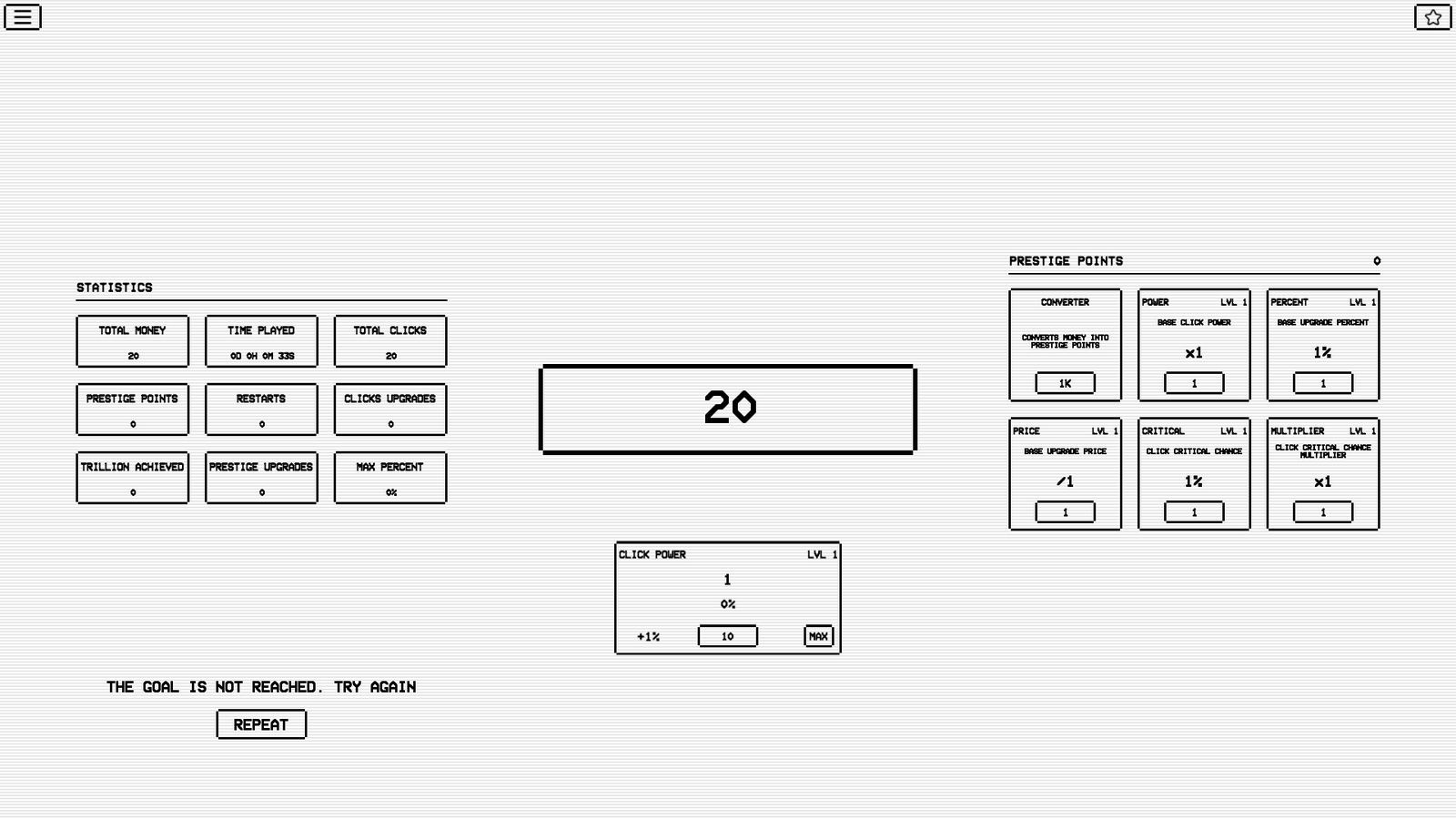
The design is a closed box on purpose. Percentage-based click scaling is the core: upgrade bonuses grow with your current value, which makes the timing of purchases matter more than raw clicking speed. A dozen-odd power-ups act as structural multipliers that change how fast your numbers scale per click. The prestige system converts early patience into permanent boosts, the only reliable way through the mathematical wall the early game puts up. Around the edges sit achievements, a Steam leaderboard, cloud saves and a minimalist aesthetic with ambient music, and nothing else. There is no passive idle safety net; this is closer to a speedrun than an idle, and it wants your full attention for all ten of its seconds.
Where it stumbles
The community reports progression-breaking bugs, including money rolling over into negative values and killing a run outright, plus late-game scaling that stalls awkwardly before the finish line. The more structural criticism is replay value: once the optimal path is known, the game is solved, and it wraps up completely once the goal is met. That is a feature of the design rather than an accident, but it means one good afternoon is the entire content offering, and mixed Steam sentiment reflects exactly that expectation gap.
Playing it today
Windows only, on Steam, at impulse pricing, with cloud saves, achievements and leaderboards attached. If the trillion itch outlasts the ten seconds, The Billion Clicker scales similar numbers into a longer loop, and Make It Rain scratches the same wealth-simulation nerve on phones.
The verdict
A clever, self-contained novelty that treats the idle genre like a speedrun. One good afternoon, then done, and it prices itself exactly accordingly.
If you like Ten Seconds Trillion
mechanic-matched
AdVenture Communist
Worth your timeThe idle game with missions instead of mindless clicking: potatoes in, Supreme Einsteins out.
AI Tycoon
A satirical idle clicker about replacing every job on Earth with AI, one agent.exe click at a time.

Bar Breaker
A clicker where the boss is the health bar itself, and it heals out of spite.

Beat Stickman: Infinity Clones
An immortal stick figure made of dark matter and ketchup exists only to be destroyed. You have 28 weapons, a potato-shaped portal device, and questionable priorities.