Bitburner
Learn to code by running a botnet: the programming incremental that teaches JavaScript through crimes.
by Daniel Xie (danielyxie) & contributors; Steam release 2022 · 2016 (web) · Web / Steam
Bitburner is the incremental for people who want their idle game to teach them something dangerous-looking: you write actual JavaScript to hack fictional servers, automate the hacks, and grow from a single home computer into a world-dominating botnet, one script at a time.
Daniel Xie built the original as a browser game in 2016, the source went open, and a 2022 Steam release brought it to a Very Positive rating across thousands of reviews plus a community that treats the game as both a toy and a coding tutor. The whole thing is free at danielyxie.github.io/bitburner.
What the loop feels like
You run a script that hacks a server, and the money arrives while you write the next script. The terminal scrolls, the RAM meter fills, and the fiction of being a cyberpunk operator holds together surprisingly well in a text window. That's Bitburner.
The scripts get longer, the servers get bigger, and automation swallows the manual hacking until your main job is supervising an empire of your own code. That's Bitburner.
The systems doing the work
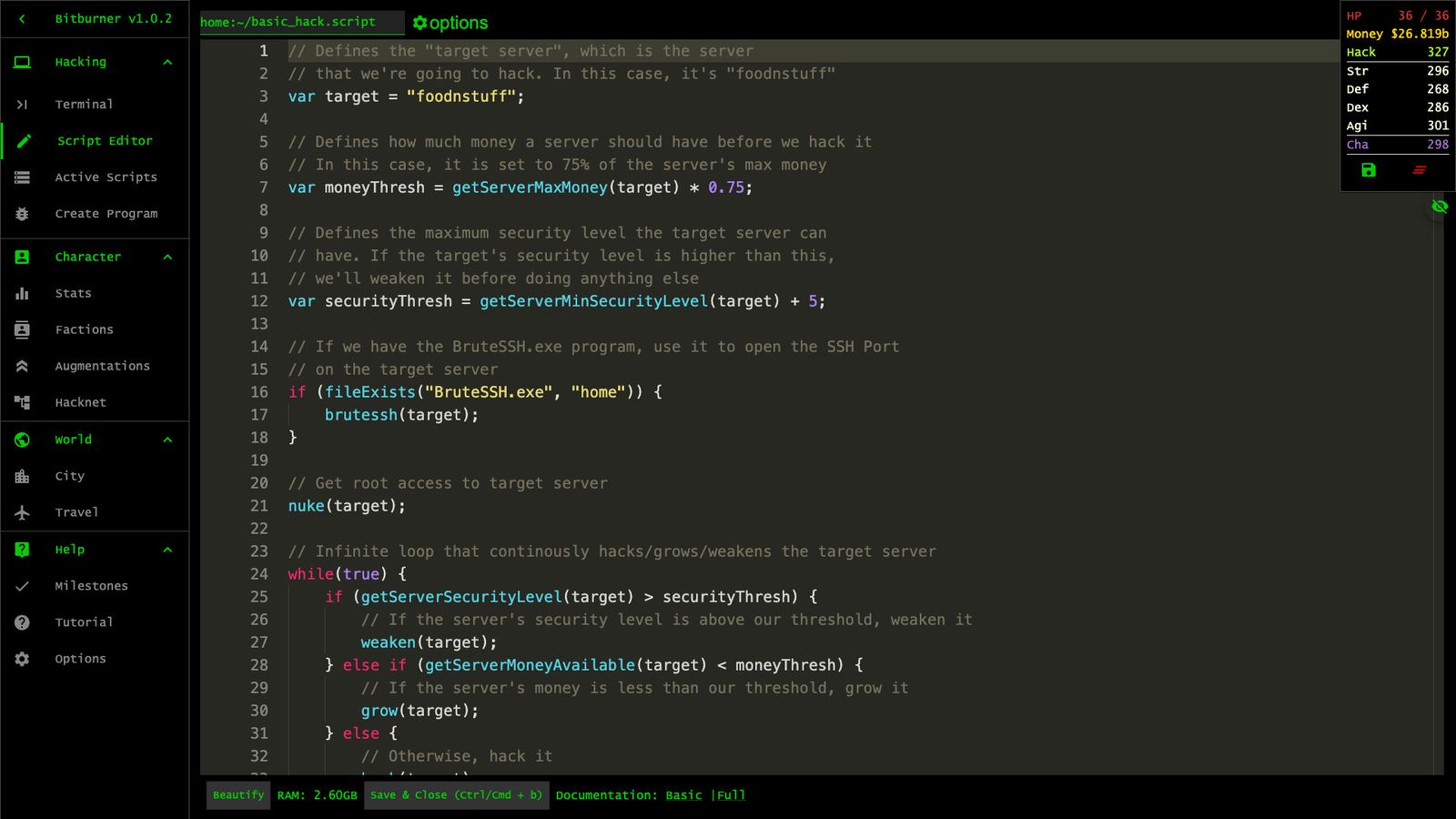
Every server has three vital stats, money available, security level and required hacking level, and your scripts manipulate them through three primary functions: hack steals a percentage of a server's money, grow increases the money available, and weaken lowers the security raised by the other two. Everything costs RAM, so early scripts must stay lightweight or live on external servers cracked open with port-opening tools like brutessh.exe, and RAM management becomes the resource puzzle underneath the fantasy.
Beyond the terminal sit factions and companies, whose memberships buy Augmentations, cybernetic upgrades to stats, hacking efficiency and RAM. The macro loop is the BitNode system: installing Augmentations is the soft reset, completing a BitNode is the hard reset into a new modifier universe, twelve of them, and finishing one earns a permanent Source-File perk. The income evolution runs from manual terminal commands and passive Hacknet Nodes, through a scanned-and-cracked botnet running coordinated batch scripts, to automated stock market trading in the late game. The special position in the genre: the automation IS the game, and improving your empire means improving your code.
Where it stumbles
The wall for non-coders is real and the community says so plainly: while the tutorials suggest programming is not strictly mandatory, hitting the mid-to-late game without writing your own automation turns the game into an uphill battle, and complete beginners can burn out if the logic does not click. The terminal interface is exactly that, a terminal, and players wanting visual feedback will find none. The conceptual filter is steep by design, which is both the game's best feature and its honest limit.
Playing it today
Free and open-source in a browser tab at the official page, with the Steam release for packaged comfort and the GitHub repository among the most active of any incremental. It is genuinely educational in a way the genre rarely attempts.
The verdict
The coding idle, and one of the very few games anywhere that has honestly been recommended as a first programming project: the idle mechanics are your code, the progression is your skill, and the botnet is a portfolio. If you have ever wanted your idle game to double as a resume, this is the one. If not, the terminal will stare back, unblinking.
Gameplay videos
Community
If you like Bitburner
mechanic-matched
Evolve
GreatFrom primordial ooze to spacefaring empire: pmotschmann's civilization-builder incremental.
Kittens Game
GreatThe Dark Souls of incremental gaming: a cat village that grows into a spacefaring civilization.
A Dark Room
★ EssentialA fire stokes. A stranger stumbles in. The village grows. You know what you did in the forest.
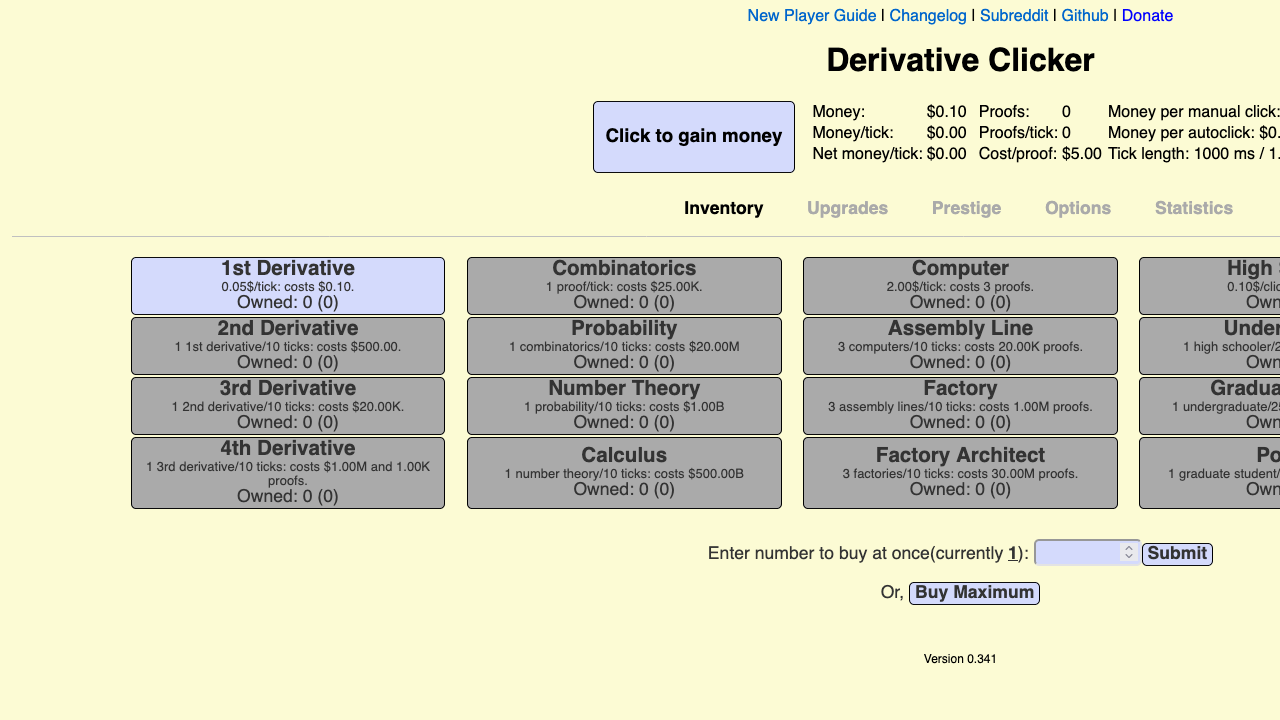
Derivative Clicker
Buy derivative generators that buy mathematicians that buy computers: calculus as an idle game.