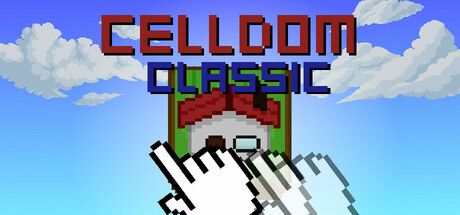
Celldom Classic
A web hit about swiping a grid instead of clicking a button, rebuilt for Steam with all its rough edges intact.
by Seyloj · 30 May, 2025 · PC (Windows)
Somewhere along the way, the humble clicker decided that clicking was optional. celldom-classic is the argument made physical: instead of hammering one static button, you drag your cursor across a grid of cells, and every cell you sweep over pays you. It started life as a web game, it arrived on Steam in May 2025, and it costs about as much as a vending machine snack.
Seyloj kept the pitch and largely kept the prototype. Whether that bothers you depends on how you feel about novelty purchases.
What the loop feels like
You sweep the board. Coins fall out. You spend the coins on the cells themselves, raising each one's base value, or on the board itself, physically growing the grid so every pass covers more ground.
That's Celldom. The act of earning is a gesture, a motion across the screen, and it feels closer to mowing a lawn than tapping a button.
Then the Dashers show up. Little automated helpers that walk the grid generating income without you, and the game quietly shifts from an active toy into a hybrid idle. That's the pivot.
And eventually your run stalls, because it always does, and you rebirth the whole board for permanent multipliers. That's the prestige cycle, familiar from every clicker since time immemorial.
How the systems fit together
The interesting tension is spatial. Because your income per second depends on how much grid your cursor can cover, expansion timing matters in a way that most clickers never ask about. Expand too early and you are dragging across half-empty real estate for pennies; upgrade your best cells first, then grow the board to match. The community advice is consistent: don't neglect the Dashers, don't over-expand, and don't hold a stalled board hostage. If growth crawls, rebirth sooner rather than later.
Honest criticisms
Players split down the middle. The fans call it exactly what they wanted: super simple, cheap, and honestly more satisfying than spam-clicking. The critics point out that there is no late game, that settings fail to save between sessions, and that the achievements demand far more playtime than the shallow content justifies. One reviewer's verdict that it feels like a prototype on itch.io rather than a completed Steam release is hard to argue with. Compared to the genre's heavyweights it has no skill trees, no narrative, and no real depth; it lives in the same shelf-space as nodebuster, though with less polish.
Playing it today
Windows-only, desktop-only, no mobile or browser version from this developer. For a bigger version of the grid-ownership idea, sixty-four is the far deeper machine-room incremental, and cookie-clicker remains the genre's reference point for what full-fat progression looks like.
Verdict: a two-dollar gesture with a spreadsheet inside it. Buy it for the feeling of swiping, not for the long haul.
If you like Celldom Classic
mechanic-matched
AdVenture Communist
Worth your timeThe idle game with missions instead of mindless clicking: potatoes in, Supreme Einsteins out.
Clicker Heroes
Worth your timeThe idle RPG that taught a whole genre to count.

Coin Flipper
Heads or tails, forever: a micro-budget incremental that reduces the entire genre to one binary outcome.
Dwarf Eats Mountain
GreatA strategic incremental about feeding dwarves to a mountain, and the logistics of getting the gold back out.