Game Development Sucks (Money)
dSolver's CodePen-era satire: make small games, chase ROI, watch the industry eat you.
by dSolver (Dacheng) · 2015 · Web (CodePen)
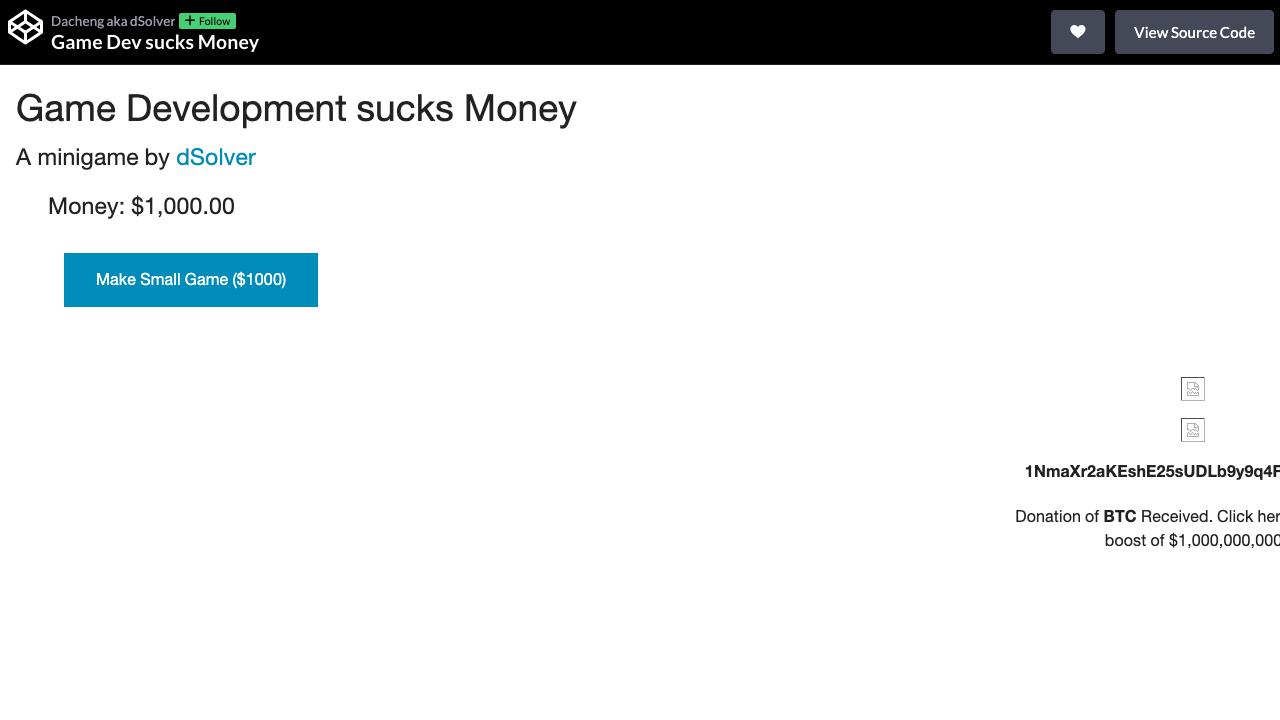
Game Development Sucks is dSolver's CodePen-era satire of the games industry, and it opens by telling you the truth: you start with $1,000, an expected ROI of 80% and 70% variance. That expected ROI is the joke and the thesis. The author states it plainly in the game's own thread: making a game is an expected loss, so it would be theoretically rather difficult to work your way up. The whole game is an experiment in whether you can beat math that is rigged against you.
What the loop feels like
You name a game, pick a project tier, and watch money drain into a progress bar. Small Game costs $1,000. When it ships, the market pays out, variance swings the result wildly around that expected loss, and the next tier tempts you: Medium Game at $20,000, Large Game at $130,000, Epic Game at $2,000,000, Legendary Game at $40,000,000. You make a small game, the market pays out, and the next game costs more. That's Game Development Sucks.
The risk management is the actual game. With 70% variance, individual projects are lottery tickets wrapped around a negative expectation, so the strategy question is how much ruin you can absorb on the way up. A Recurring Sales toggle at the start changes how revenue arrives. And if the math gets to you, the UI offers a visible Throw $NaN at project action, a bug the author left in as a punchline about the industry's accounting. That's Game Development Sucks.
The systems doing the work
Underneath the satire is a real expected-value model: cost, expected ROI and variance are all visible, and every project resolves against them. There is no automation layer, no prestige and no endgame; it is a minigame about one brutal distribution, sized for a coffee break. dSolver built it open source on CodePen in the mid-2010s, early in a career that later produced Click Click Wroom and other incrementals.
Where it stumbles
Documented criticism is scarce because the game is obscure, but the design is honest about its own limits: a single loop, a handful of tiers and a lot of variance means sessions are short and outcomes are swingy in a way that can feel arbitrary rather than fair. Players looking for incremental depth will find a sharp gag with working math instead, which is presumably the point.
Playing it today
Free at CodePen, where dSolver hosted several of his early games. Both screenshots above are fresh captures; the pen is open source, so the math is inspectable right in the source.
The verdict
A five-minute satire with sharp numbers under the joke: the ROI math is real, and so is the pain. An early dSolver piece worth playing before his longer games.
If you like Game Development Sucks (Money)
mechanic-matched
CityClicker
Zone residential, commercial and industrial tiles: a SimCity-flavoured text incremental.

Clicking Bad
Worth your timeCook meth, sell it, dodge the DEA: the Breaking Bad clicker that outlived its own show's finale.

Conspiracy Clicker
Worth your timeRun a conspiracy org across industry, media and politics until the New World Order is your org chart.
Crushing Defeat
Each product generation is better, and improves the longer you wait: Hamilton Cline's patience idle.