
Megami Quest
The goddess-raising gacha idle: Shinmage's 2013 original, http-only and quietly alive.
by Shinmage (shimage.net) · November 2013 · Web (shimage.net)
A goddess idle from the era when browser games were made by one person and a jQuery file. Megami Quest, on the Japanese site shimage.net since around 2013, gives you a party of pixel goddesses, points them at monsters, and lets the fighting run itself: click a location, the party auto-battles for experience and gold, and the game mostly plays while you watch.
It survives, which is the first surprise. The official English page still answers, though only over plain HTTP because the site never grew a TLS certificate, so your browser will warn you before the goddesses do anything. The second surprise is lineage: it spawned a sequel, Megami Quest 2, and a small fandom that treats the pair as a cult classic of the idle-RPG microgenre.
What the loop feels like
You click a map location and the party walks in and starts fighting on its own. Experience ticks up, gold ticks up, and nobody asks you to press anything else. That's Megami Quest.
Then the gold gets spent, and the gacha-flavoured heart of it opens: summon new party members, add goddesses to the roster, and push the party deeper into zones that used to be too dangerous. That's Megami Quest.
Goddesses, zones and the roster
The systems are lean and legible. Zones each hold monsters tuned to a difficulty band, and the active decision is which party to send where; the idle half is leaving a safe zone farming while you do something else. Gold converts into summons, summons convert into a deeper roster, and the roster is the real collection: each goddess has her own sprite strip, stats and quirks, and the party-building is where the mild strategy lives.
Saves live in localStorage with export and import, the survival trick that has kept this game recoverable across a decade of dead browsers. There is no prestige layer and no meta-currency; the whole design is a straight line from clicking a location to affording the next goddess, and it trusts the roster to be interesting enough to carry it.
Where it stumbles
Age shows in every direction. The presentation is a handful of sprites and boxes, the balance is early-2010s casual, and there is no real endgame to speak of, just progressively tougher zones. The English is functional rather than graceful. Documentation is thin: a wiki effort on r/incremental_games and a listing on the /v/ recommended-games page are about the whole written record, so the deeper roster details are the community's oral history. And the HTTP-only hosting means the game's long-term survival depends on one small site never going down.
Playing it today
The official English page is here, served over plain HTTP, so expect a browser warning before it loads. Export your save early and often. The sequel lives on the same domain if the first one hooks you.
The verdict
A museum piece that still runs: minimal, self-playing, and quietly charming, with a goddess-roster hook that earns the gacha comparisons without the gacha wallet. Give it an evening, export the save, and decide whether the sequel gets the next one.
If you like Megami Quest
mechanic-matched
Evolve
GreatFrom primordial ooze to spacefaring empire: pmotschmann's civilization-builder incremental.

Exotic Matter Dimensions
Worth your timeLoosely inspired by Antimatter Dimensions, entirely its own game: axes, stars, wormholes, 10^500B.

Idle Royale
Worth your timeWrite JavaScript, race bots to 2×10¹⁰: angarg12's competitive scripting idle.
Incremental Wall
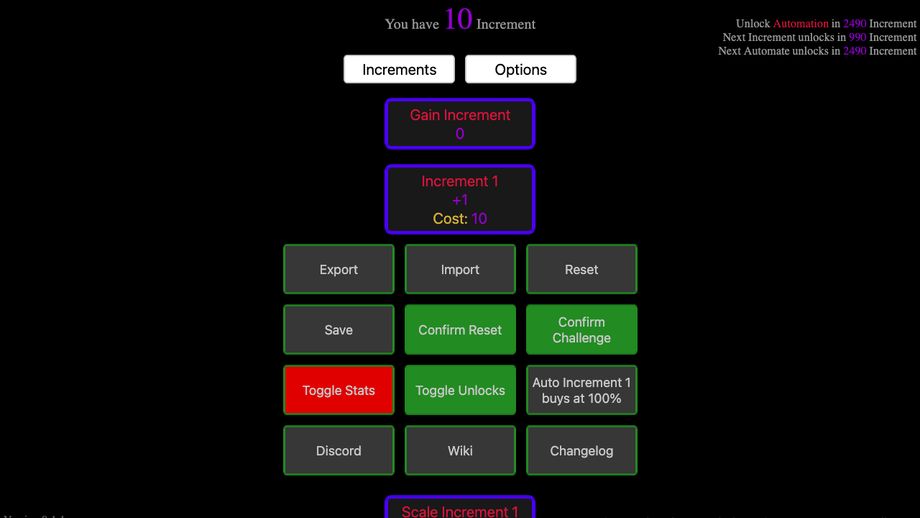
A minimalist wall of numbers: Geogolf's two-layer prestige incremental, discontinued by its own notice.