
The Big Book of Monsters
Customize heroes, pump stats, master alchemy timers, and read the monsters their last chapter.
by Sam Cherry · 6 Dec, 2024 · Steam
The Big Book of Monsters frames its incremental systems as pages in a bestiary, which is a nicer way to file your progress than a spreadsheet. Sam Cherry, developing and publishing solo, brought it to Steam Early Access in December 2024 with a promise of customized heroes, unique enemies across adventures, alchemy timers, and a prestige system where strategy shapes the path. The genre beneath the parchment is pure incremental: stats, automation, resets.
What the loop feels like
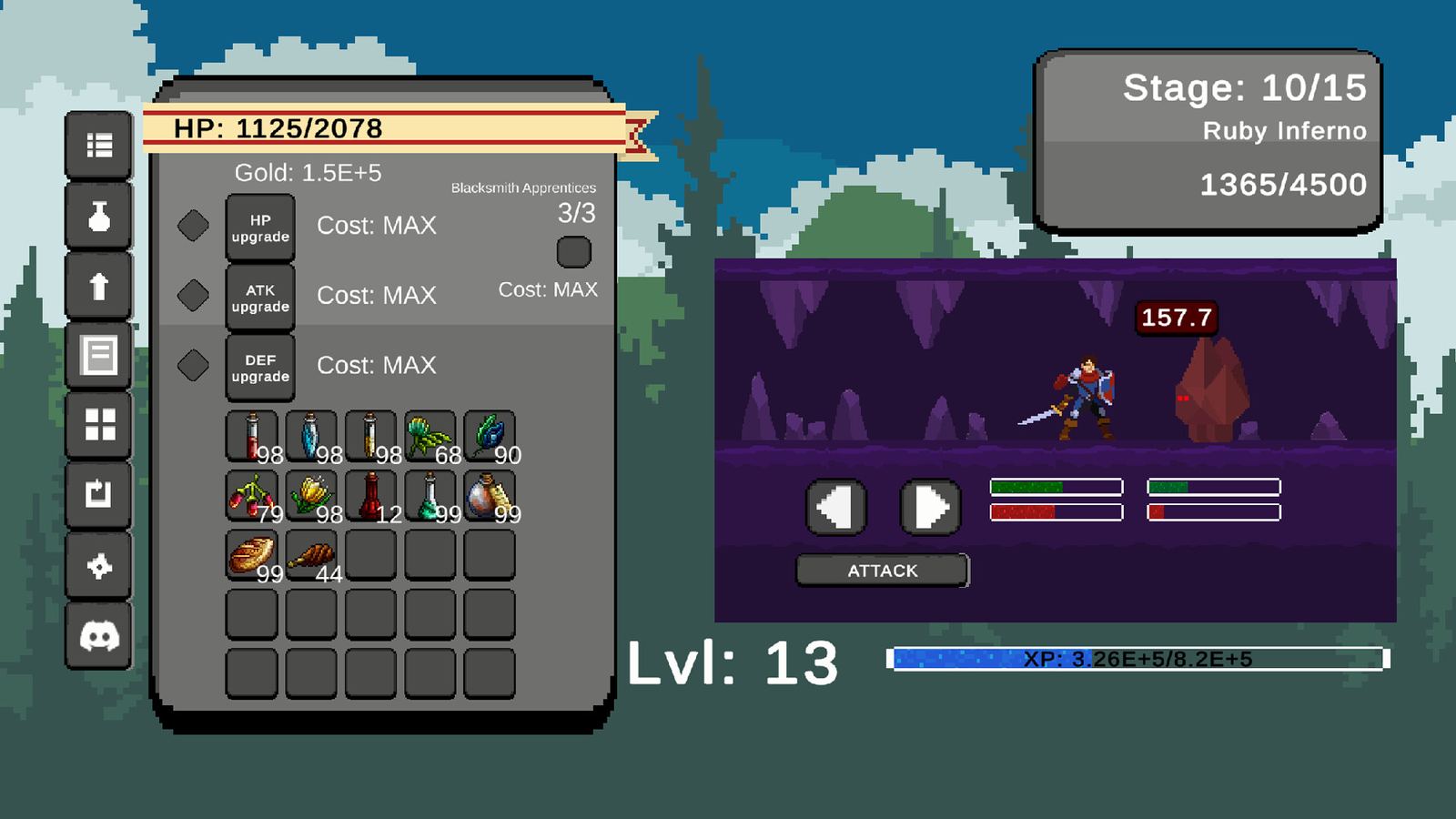
It plays like a notebook that fights back. You customize a hero, send them into adventures against the book's residents, and come back to pump the raw stats that make the next chapter survivable. The rhythm is stat management with a plot of paper between bouts. That's The Big Book of Monsters.
Alchemy timers give the between-time its texture. Potions tick over in the background, automation quietly advances your numbers while you rework the character sheet, and the prestige layer eventually lets you close the book and open it again on page one, permanently stronger. For a solo-made bestiary, the mechanical table of contents is surprisingly complete. That's The Big Book of Monsters.
How it actually works
Four systems carry it. Dynamic stat and hero upgrading is the spine: combat and progression revolve around continuously pumping stats and unlocking active and passive abilities rather than moment-to-moment action. Tiered stat unlocks convert that pumping into real damage and survivability thresholds. Automation loops handle the grinding once configured, clearing encounters and gathering resources while you optimize the macro layer. Prestige closes the loop, trading current progress for permanent legacy bonuses that push deeper into the book on later runs. Community strategy, thin as it is, converges on three habits: buy automation early, prestige when a run slows to a crawl rather than stalling, and specialize a build along one scaling path instead of spreading points evenly, because boss checks punish generalists.
Where it stumbles
The honest warnings come in threes. The community footprint is nearly nonexistent: player trackers often log zero concurrent players, Steam discussion is sparse, and there is effectively no Reddit presence dedicated to this specific title. The content is described as extremely minimal even by Early Access standards, with progression systems that feel bare-bones next to mainstream incrementals, more proof-of-concept than polished time sink. And everything depends on one developer, so the roadmap is a single person's spare time. Worth noting too that the name collides with The Big Book of Madness, a well-known cooperative board game, which absorbs most of the search results and some of the audience.
Playing it today
A Windows Early Access release on Steam, priced like a coffee. For monster-file incrementals with more history behind them, Knights and Dungeons and Idle Quest are covered in depth on this site.
The verdict
A small, earnest Early Access bestiary with real incremental bones and a lonely community wing. Read it early if you enjoy watching solo projects grow, or wait until the book has more pages.
If you like The Big Book of Monsters
mechanic-matched
AdVenture Communist
Worth your timeThe idle game with missions instead of mindless clicking: potatoes in, Supreme Einsteins out.

Celldom Classic
A web hit about swiping a grid instead of clicking a button, rebuilt for Steam with all its rough edges intact.
Clicker Heroes
Worth your timeThe idle RPG that taught a whole genre to count.
Clicky Coven
A witch assembly line where the bottleneck is real and the cauldrons can outpace the harvest.