A-Z Inc
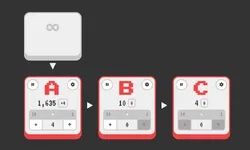
One infinity card. Twenty-six letters. An economy in alphabetical order.
by Xecutor · 2017 · Web
The whole economy is the alphabet. One card marked with an infinity symbol makes letters, and every letter you own becomes the raw material for the next letter up, A through Z, and when Z is finally yours the game tells you that you beat A-Z Inc. It starts with everything and works backward: you spend infinity down to make A, and everything after that is arithmetic.
Xecutor built it in 2017 as a compact web project, a chance to learn React, TypeScript and Webpack that accidentally produced one of the cleanest generator-chain toys in the genre. It is still up free at xecutor.github.io/azinc, finished and frozen, exactly as the community wiki lists it.
What the loop feels like
You buy the letter B, and the letter B makes more letter A's possible. The first few conversions are manual and honest: ten lower letters craft one of the next tier, so a single C clicked out by hand takes over a hundred conversions. That's A-Z Inc.
Then the auto-converters arrive, the chain deepens, and around letter M you realise you are no longer playing a clicker but managing an alphabet that manages itself. That's A-Z Inc.

The systems doing the work
The alphabetical conversion chain is the spine: ten units of a lower letter craft one of the next, all the way from A to Z. Auto-converters are the automation layer, and their pricing is the puzzle: upgrading the converter for tier N costs letters from tier N+1, so every piece of automation is paid for by the thing above it, a recursive balancing act that never quite lets you ignore a lower tier.
Progression moves in phased letter sets. Early letters peak and cap quickly while later blocks act as multipliers and accelerators for earlier tiers, and the community's collected strategy reflects that: push the eleventh-tier milestone once preceding tiers are stable, prioritise double-production upgrades from the first block then the last block and work inward, and take the set four multipliers early to stabilise the mid-game before finishing sets one, three and five. The late game is the shift from active balancing to buying bulk multipliers and letting the engine run itself to Z.
Where it stumbles
The quality-of-life cracks showed early: launch feedback flagged the lack of a manual save button and small interface bugs like auto-converter toggles that occasionally registered extra clicks. Scope is the bigger limit, and an honest one: this was a learning project, not a live service, so it is short, finite, and ends without prestige layers or deep endgame content. Against heavyweight idlers like Antimatter Dimensions it is vastly simpler, a concept executed once rather than a world built out.
Playing it today
Play it free in the browser at the original GitHub Pages build, and note the community-restyled version on galaxy.click if you want the same math in a different skin. There is no Steam release, no mobile port, and nothing to buy, which suits a game that fits in a lunch break.
The verdict
One of the purest expressions of the generator-chain idea the genre has, dressed in nothing but letters and ending exactly when it should. The gimmick is elegant, the strategy layer is real for its size, and the rough edges are the honest cost of a solo learning project from 2017. A to Z in the most literal way possible.
Community
If you like A-Z Inc
mechanic-matched
A Dark Room
★ EssentialA fire stokes. A stranger stumbles in. The village grows. You know what you did in the forest.
Bead Machine: Punktasia
A text-based machine-builder about making beads, by the developer of the Punktasia family.
CivClicker
Worth your timeClick wood, found a thorp, raise an empire: the 2011 ancestor of civilization incrementals, kept alive by its community.
Derivative Clicker
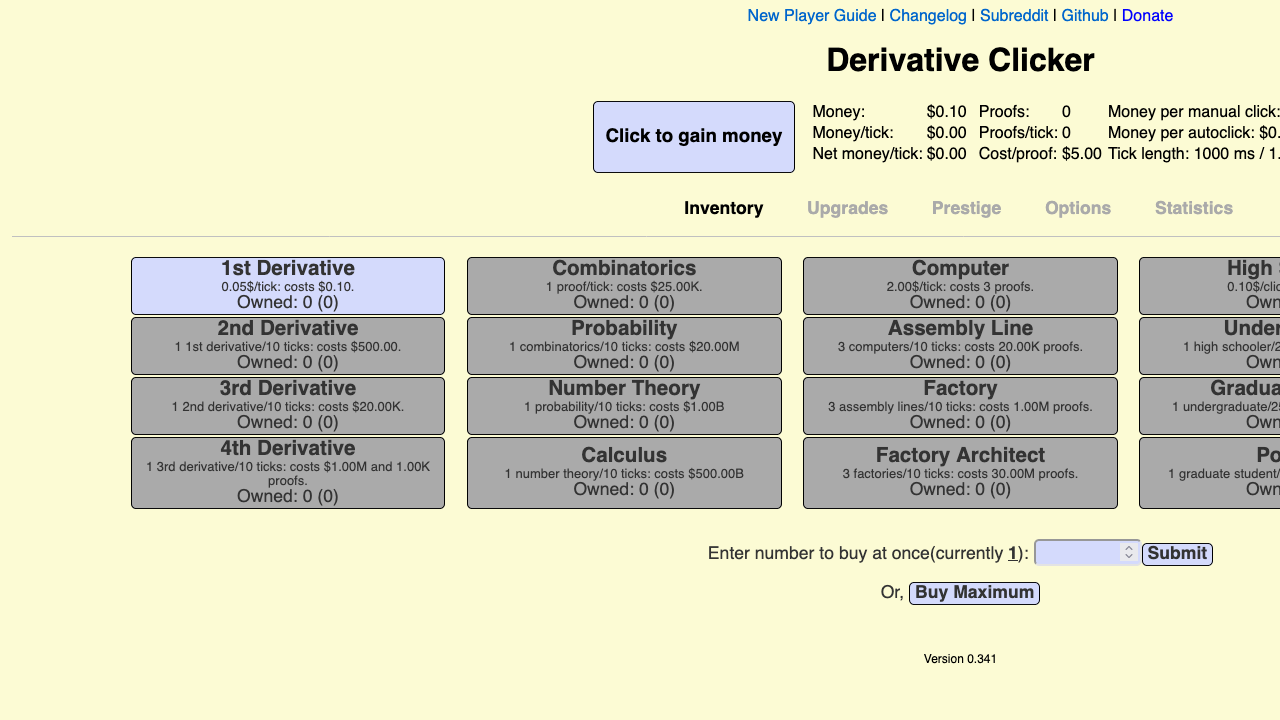
Buy derivative generators that buy mathematicians that buy computers: calculus as an idle game.