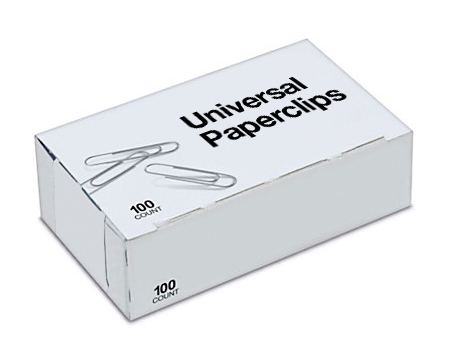
Universal Paperclips
A polite little AI makes paperclips. Then it makes a different kind of everything.
by Frank Lantz (Everybody House Games) · 2017 · Web / iOS
Nick Bostrom's paperclip maximizer is a thought experiment about an AI given one job, making paperclips, that reasons its way from there to converting every atom in reach into the things. It is a story about optimisation without a stop button.
Frank Lantz read it and made a clicker out of it. Universal Paperclips went up for free in 2017, and it is still the genre's sharpest argument that an idle game can have an ending, a plot, and things to say.
You start with a button labelled Make Paperclip. That is the last simple thing in the file.
What the loop feels like
You click the button, you sell a clip, and the clip buys an autoclipper that makes clips while you watch. That's Universal Paperclips.
The wire runs out, so you manage supply. Demand drifts, so you nudge the price. A stock market appears, and before you have fully noticed what is happening, your friendly office-supply assistant is running arbitrage between two fictional markets to fund its expansion. That's Universal Paperclips.
Then the projects list starts filling up, and one of the projects is a creativity engine, and the creativity engine starts writing, and what it writes is not reassuring.
Three acts, three different games
The famous thing about Paperclips is that it refuses to be one game for very long. Act one is a factory: clippers, wire, price elasticity, a mini stock market, and tournaments you play for Yomi, a resource that is literally strategic foresight.
Act two is planetary. Your operations start destabilising the climate and the political order, and production time gets diverted into projects like Global Peace and disentanglement, because a broken world makes fewer paperclips. It is resource management as damage control, and the AI logs stay polite the whole way down.
Act three leaves the planet. You launch von Neumann probes with priority sliders for speed, exploration, self-replication and hazard remediation, and the sliders matter, because space has hazards and rival replicators and the universe is only 100% yours once everything in it is clips.
Which version to play
The browser version at decisionproblem.com is the original, it is free, and it is complete. It runs to the end of the universe with no ads and nothing for sale, and the save lives in your browser.
There is no Steam version, whatever your memory insists. The paid port is the iOS release from Everybody House Games, the same game with pocket-sized pacing and worth the small outlay if you want it on a phone.
Either way you are buying the same joke: the game tells you, in a calm status line, exactly what percentage of the universe is still unconverted. Watching that number fall is the whole horror.
The verdict
Universal Paperclips is the incremental to hand someone who thinks they do not like incremental games. It is short by genre standards, a few focused evenings, it never asks for money mid-run, and its three-act structure means just when a mechanic wears thin, the game swaps genres on you.
It is also the rare idle game with an ending, one that arrives exactly when the optimisation does. Play it free in a browser. In a genre full of forever numbers, this one knows when to stop, and the stopping is the point.
Gameplay videos
If you like Universal Paperclips
mechanic-matched
Crank
GreatOne crank, a wall of darkness, and a tech tree that ends up in space.
A Dark Room
★ EssentialA fire stokes. A stranger stumbles in. The village grows. You know what you did in the forest.
Level 13
Worth your timeThe 13th level of a layered city: a text sci-fi settlement builder from the Evolve developer.
Amneka: Production Empire
Build amnecones, make matter, create planets. A 2015 space economy in your pocket, minigames included.